
A large number of women from various states reached the sites of protest against the Centre's three farm laws that has been going on for over 50 days now.

Farmer leaders said unions do not allow any political party to use their stage and accused the government of diverting the issue.

The Supreme Court on Tuesday ordered a stay of the implementation of the contentious three new farm laws hoping this will end the prolonged protests by the farmers and also constituted a four-member panel of agri experts to resolve the impasse between their leaders and the Centre.

Over 3,500 police personnel have deployed as the farmers began their march from the Ramlila Maidan to Parliament at 10.30 am.

Ten central trade unions on Tuesday said they are going ahead with their planned nationwide general strike on November 26 and also announced their support to a two-day farmers' agitation next week. The meeting of the Joint Platform of Central Trade Unions (CTUs) and Sectoral Independent Federations and Associations was held virtually on November 16, 2020. Unions expressed satisfaction over the tremendous response being received from workers and the people at large throughout the country to the ongoing campaign for the countrywide general strike on November 26, 2020, a joint forum statement said.

He also said that train services will resume after the state government and protesting farmer unions assure the safety of the tracks. Tomar and Union Food, Commerce and Railways Minister Piyush Goyal held a day-long meeting with representatives of various farmer unions at Vigyan Bhawan in New Delhi.
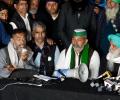
As cracks began to appear in their ongoing agitation against the agri laws, farmer unions on Wednesday cancelled their planned march to Parliament on February 1 when the Budget would be presented.

"The cancellation of the UK prime minister's visit because of all these efforts is surely a big victory for farmers," the statement said.

The minister said that the last meeting held on December 30, 2020, happened in a cordial atmosphere and there is a possibility of positive results in the interest of farmers and of the country's farm sector at the next meeting.

The farmers' acceptance of the proposal came hours after the Centre sent them a letter suggesting December 30 as the date for the dialogue, against December 29 the protesting unions wanted.
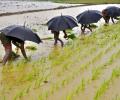
The opposition would push for the passage of the two bills -- the farmers' freedom from indebtedness bill and the farmers' right to guaranteed remunerative minimum support prices for agriculture commodities bill -- in the Rajya Sabha

He said the farmer's agitation in Punjab against the new farm laws could lead to 'serious consequences' for national security and alleged that China and Pakistan were seeking to disturb peace in the country's border state. Stressing that his intention was not to disturb peace, Singh said he was trying to 'save' his state's farmers as the Centre was 'playing with' their livelihoods.

Police said the border has not been sealed but they are checking all vehicles entering the national capital.

Union leaders, who came out of the meeting venue shouting slogans, said the talks remained deadlocked and some of them threatened to boycott any further meetings if no solution was found at Thursday's meeting.

He also urged people demonstrating against the laws across the country to observe a day-long hunger strike at their respective protest sites.

Congress leaders Digvijay Singh, Sachin Pilot and Rita Bahuguna Joshi were arrested by the Uttar Pradesh Police at the Delhi border on Tuesday, when they were going towards state Chief Minister Mayawati's village to protest against the 'coercive' acquisition of land.The leaders were prevented at the Delhi-UP border by the UP police from going towards Badalpur, the village of Mayawati, where the Uttar Pradesh Congress Committee has organised a 'Kisan Sangharsh Rally'.

Here are some of the key farmer leaders who fronted the protests.

We are ready to talk but will not accept any condition now," said a farmer's leader.

The ten trade unions are National Trades Union Congress, All India Trade Union Congress, Hind Mazdoor Sabha, Centre of Indian Trade Unions, All India United Trade Union Centre, Trade Union Coordination Centre, Self Employed Women's Association, All India Central Council of Trade Unions, Labour Progressive Federation and United Trade Union Congress.

Yogendra Yadav said the decision to defer the march was taken over a forecast of bad weather conditions on Wednesday.

Thousands of farmers, mainly from Punjab and Haryana, are protesting at various borders of the national capital for more than a month against the laws and are demanding that these be repealed.

Bharatiya Kisan Union (BKU) leader Rakesh Tikait said that the government, in its letter, mentioned that it wants to hold talks over its earlier proposal of amendments in the new agri laws.

Most of the farmers have brought at least two trolleys with each tractor with one of them carrying ration and other essentials and the other being used to accommodate the protesters.

Farmer leader Joginder Singh Ugrahan said told reporters after the meeting that the unions urged the government to repeal the three laws, but the Centre was unwilling to do so. "We decided to meet again on January 19 at 12 pm," he said.

The government and the farm unions had reached some common ground on Wednesday to resolve the protesting farmers' concerns over rise in power tariff and penalties for stubble burning, but the two sides remained deadlocked over the main contentious issues of the repeal of three farm laws and a legal guarantee for MSP.

The farmer representatives were unanimous in seeking repeal of the 3 laws.

'On one side you have the farmers of India and on the other side are few corporate families.' 'Unfortunately, those holding the levers of power today are more sympathetic towards these corporate families and helping them benefit at the cost of poor farmers.'

Banded under the All India Kisan Sangharsh Coordination Committee, which claims to be an umbrella body of 207 organisations of farmers and agricultural workers, thousands of farmers arrived in Delhi on Thursday, on trains, buses and other modes of transport. The AIKSCC was formed under the aegis of All India Kisan Sabha and other Left-affiliated farmers' bodies in June 2017, following protests by farmers in states such as Maharashtra and Madhya Pradesh for debt relief and remunerative prices. On Friday, they marched to Parliament demanding for loan waivers and increased remuneration. Adnan Abidi/Reuters was able to photograph different farmers participating in the rally. The one takeaway: They may all look very different, but their woes are all the same.

Ayyakannu, who is also president of the National South Indian Rivers Inter-Linking Farmers Association, said the decision to contest the polls from Uttar Pradesh was to urge the Bharatiya Janata Party to include in their manifesto that their demands, including "profitable prices for farm produce," would be fulfilled.
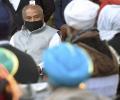
Speaking to reporters after the meeting that lasted for little over two hours, Tomar said the government is still hopeful that union leaders will come with alternatives to discuss in the next round of talks on January 15.

Thousands of farmers have reached the national capital on their tractor-trolleys and other vehicles, responding to the 'Delhi Chalo' call against the agri-marketing laws enacted at the Centre in September. On Saturday morning, it wasn't clear if they will agree to move to the Burari ground on the outskirts of the city, where police said they can continue with their protest. Many protesters were demanding a better venue in the centre of Delhi. Originally, the protest was meant to be on November 26 and 27.

For over three months, the three Delhi border points at Singhu, Tikri and Ghazipur have transformed into townships occupied by thousands of farmers from different parts of the country, mainly Punjab, Haryana and western Uttar Pradesh.

The two-day rally will be one of the largest congregations of farmers in Delhi, the AIKSCC has claimed.
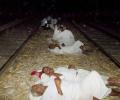
Gujjars remained adamant for calling the committee of ministers at Bayana in Bharatpur for holding talks to resolve the issue

Talks resumed in Jaipur on Wednesday between Rajasthan government and agitating Gujjars who have been blocking rail tracks and roads in three districts for a week now to press for five per cent quota in government jobs.
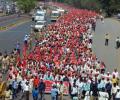
In the coming four months from August, agitating farmers will hold 400 meetings across the country to highlight farmers' issues and protest against government claims, reports Sanjeeb Mukherjee.

The seventh round of talks between protesting unions and three central ministers ended inconclusively on Monday as the farmer leaders insisted on the repeal of the three contentious farm laws right from the beginning, even as the government listed various benefits from the Acts.

Fadnavis assured them of transferring land rights within the next three months.

'The Modi government is not listening to us. So now we are coming to Delhi to talk with the central government.'

'One investor told us one leader in Gujarat had sent him to Konkan to buy land.' 'How did these people come to know about this project in advance when locals didn't know?' 'It means those who are running the country are somewhere interested in selling the country's resources to private businessmen.'
 © 2026 Rediff.com - Advertise with us - Disclaimer - Privacy Policy - Sitemap - Feedback - About us - Terms of use - Grievances